
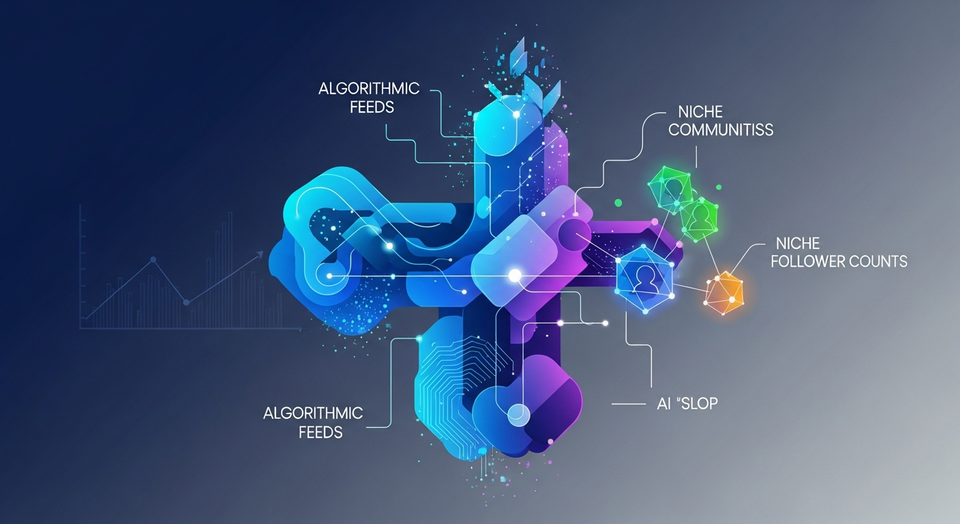
Follower counts used to signal reach, influence, and earning power. But in 2025, creators and the companies that work with them are adjusting to a new reality: posting to a large audience no longer guarantees that audience will actually see the post.
Algorithms took the wheel—and creators feel it
As algorithmic feeds dominate major platforms, distribution has shifted away from “who follows whom” and toward what a platform’s recommendation engine decides to surface in the moment. LTK CEO Amber Venz Box described 2025 as the year the algorithm fully took over, to the point where followings “stopped mattering entirely,” in her view.
This dynamic isn’t exactly new to longtime creator-economy observers—Patreon CEO Jack Conte has been warning about it for years—but the broader industry response is evolving. Executives speaking about what’s next for creators described two simultaneous trends: creators trying to strengthen direct relationships with their audiences as a defense against low-quality, AI-generated content, while other tactics risk adding even more noise to already crowded feeds.
Trust becomes the scarce resource
For businesses built on creator credibility, the erosion of straightforward distribution poses a real challenge. LTK, for example, connects creators and brands through affiliate marketing, a model where creators earn commissions by recommending products. That approach depends on audiences trusting individuals enough to act on their recommendations.
Despite worries that algorithmic fragmentation could weaken creator-audience bonds, Box pointed to a more encouraging signal: a study LTK commissioned with Northwestern University found that trust in creators increased 21% year-over-year. Box said that outcome surprised her, given that more consumers now recognize the creator economy as a professionalized industry.
Her explanation ties directly to the rise of generative AI. As AI-generated content proliferates, she argued, people may be “rotating” their trust toward humans who have real experiences and established credibility. In practice, that can mean consumers actively seeking out creators they know and trust instead of passively waiting for a feed to deliver their posts.
The same study cited by Box also indicated that 97% of chief marketing officers plan to increase influencer marketing budgets in the new year—suggesting that, even as distribution becomes less predictable, marketers still see creators as a channel worth investing in.
Owning the audience isn’t simple anymore
Even if trust is rising, “owning” the relationship with an audience has become more complicated. Creators who rely on affiliate income may lean into more direct connections—through paid fan communities, for instance—or toward environments that feel less dominated by recommendation engines, including LTK’s own platform.
But that approach doesn’t map neatly onto every creator business model. For streamers, video podcasters, and short filmmakers—especially those chasing broad awareness—the playbook can look closer to growth hacking: finding repeatable ways to trigger algorithmic distribution even when a creator can’t reliably reach their own followers.
“Teenage clipping armies” and the new distribution hacks
Sean Atkins, CEO of short-form video production company Dhar Mann Studios, framed the central challenge like this: when AI and algorithms drive attention and “micro atomization” pushes people to trust other humans in narrow contexts, marketing becomes harder because distribution is less controllable.
One emerging workaround, according to Eric Wei, cofounder of creator-focused financial services company Karat Financial, is what he described as “armies of teenagers” on Discord. In this model, creators pay these teens to clip highlights from longer content—often streams—and then post those short clips at scale across algorithmic platforms.
Wei said the tactic has existed for a while among major names, and he pointed to examples including Drake and top streamers. He also referenced Twitch star Kai Cenat as someone who has used clipping to generate millions of impressions.
The logic is straightforward in an algorithm-first world: a platform may not care whether the clip is posted by the original creator or by “any random account” if the video performs well. With the right highlight, a clip can spread widely even from an account with no established following. For clippers, the incentive is financial—posting a viral highlight can translate into earnings tied to view counts.
Glenn Ginsburg, president of youth-focused content company QYOU Media, compared clipping to an evolution of meme accounts. The practice, he suggested, can turn into a competitive sprint where multiple accounts try to push the same intellectual property across feeds, each vying for the biggest view totals.
Night’s Reed Duchscher: clipping helps, but scaling it is messy
Reed Duchscher—the founding CEO of talent management company Night, which represents Kai Cenat and other top creators—has been closely associated with maximizing creator virality. As MrBeast’s former manager, Duchscher helped develop the fast-paced, attention-optimized style that played a role in turning MrBeast into a much larger business empire. He’s also linked to Kai Cenat’s clipping approach.
Still, Duchscher offered a more cautious view of clipping’s broader potential. He emphasized that creators do benefit from “flooding the zone” with content and that clipping can be a practical way to increase surface area across platforms. But he also said it’s difficult to scale because there are only so many clippers available—and trying to deploy large media budgets into this system introduces complications.
There’s also a potential shelf-life problem. Clipping may be effective partly because it hasn’t yet become so ubiquitous that audiences and platforms treat it as spam.
Wei acknowledged the risk more bluntly: while creators gain distribution and clippers get paid, the end result—if pushed to its extreme—could be “lots and lots of slop.”
AI “slop” and the flight to smaller, real communities
The word “slop” has become shorthand for low-effort, repetitive, or AI-generated content that floods feeds and degrades the user experience. Its cultural saturation reached the point where Merriam-Webster named “slop” its word of the year.
Box argued that users are already reacting. She cited survey results indicating that over 94% of people believe social media is no longer truly social, and that over half are redirecting their time into smaller niche communities where they feel interactions are real and conversational. She pointed to examples such as Strava, LinkedIn, and Substack.
This shift matters for creators for two reasons:
- Distribution is changing shape: rather than relying on a single massive feed, audiences may increasingly fragment into topic-driven spaces.
- Engagement quality may matter more than raw reach: in smaller communities, trust and interaction can be more valuable than passive impressions.
The more niche the better, as “macro creators” get harder to replicate
As creator-audience relationships become harder to maintain at scale, Duchscher expects more specialized creators to win. In his view, it will become even more difficult to replicate the success of “macro creators” like MrBeast, PewDiePie, or Charli D’Amelio—creators who built audiences in the hundreds of millions and achieved unusually broad cultural reach.
He contrasted that with creators who still reach millions but aren’t necessarily built for universal appeal, citing Alix Earle and Outdoor Boys as examples. Duchscher’s underlying point is that recommendation systems have become extremely good at serving people exactly what they want. That personalization makes it harder for one creator to break out across every niche algorithm at once, because each audience cluster is effectively its own distribution universe.
The creator economy is bigger than entertainment
Atkins also cautioned against treating the creator economy as synonymous with entertainment alone. He argued that the creator model is more like the internet or AI in its broad impact: it can touch nearly every industry and category.
As an example, he highlighted the gardening creator brand Epic Gardening. What began as a YouTube channel expanded into a tangible presence in the gardening market. Atkins said Epic Gardening bought the third largest seed company in the United States, making its creator-founder the third largest seed company owner.
That kind of expansion underscores why shifts in distribution mechanics—like algorithms downplaying follower graphs—aren’t just a “social media problem.” They can affect how audiences discover experts, how brands allocate budgets, and how creator-led businesses grow beyond content into commerce, products, and services.
Conclusion
In a world dominated by algorithmic feeds, follower counts are losing their old power as a reliable proxy for reach. Creator trust may be rising even as AI “slop” spreads, and strategies like clipping and niche community-building are emerging as ways to adapt. The creators most likely to thrive may be those who cultivate clear niches, strengthen direct relationships, and build business models that don’t depend on a single platform’s shifting distribution rules.
<<>>
Related Articles
- Meta Acquires Manus: Why the Fast-Growing AI Agent Startup Matters for Facebook, Instagram, and WhatsApp
- Investors Reveal What Makes a Startup Pitch Stand Out in a Crowded Market
- US TikTok Deal Explained: Who Owns TikTok in the U.S. and What Changes for Users
Based on reporting originally published by TechCrunch. See the sources section below.
Sources
- TechCrunch
- https://onbrand.shopltk.com/en/latest-news/ltk-and-northwestern-university-retail-analytics-council-release-annual-cmo-creator-marketing-study-creators-are-1-increased-investment-in-2026
- https://www.youtube.com/c/kaicenat
- https://www.youtube.com/@epicgardening